Fashion for Good launches Project FAE to unlock post‑consumer textile feedstock for large‑scale recycling
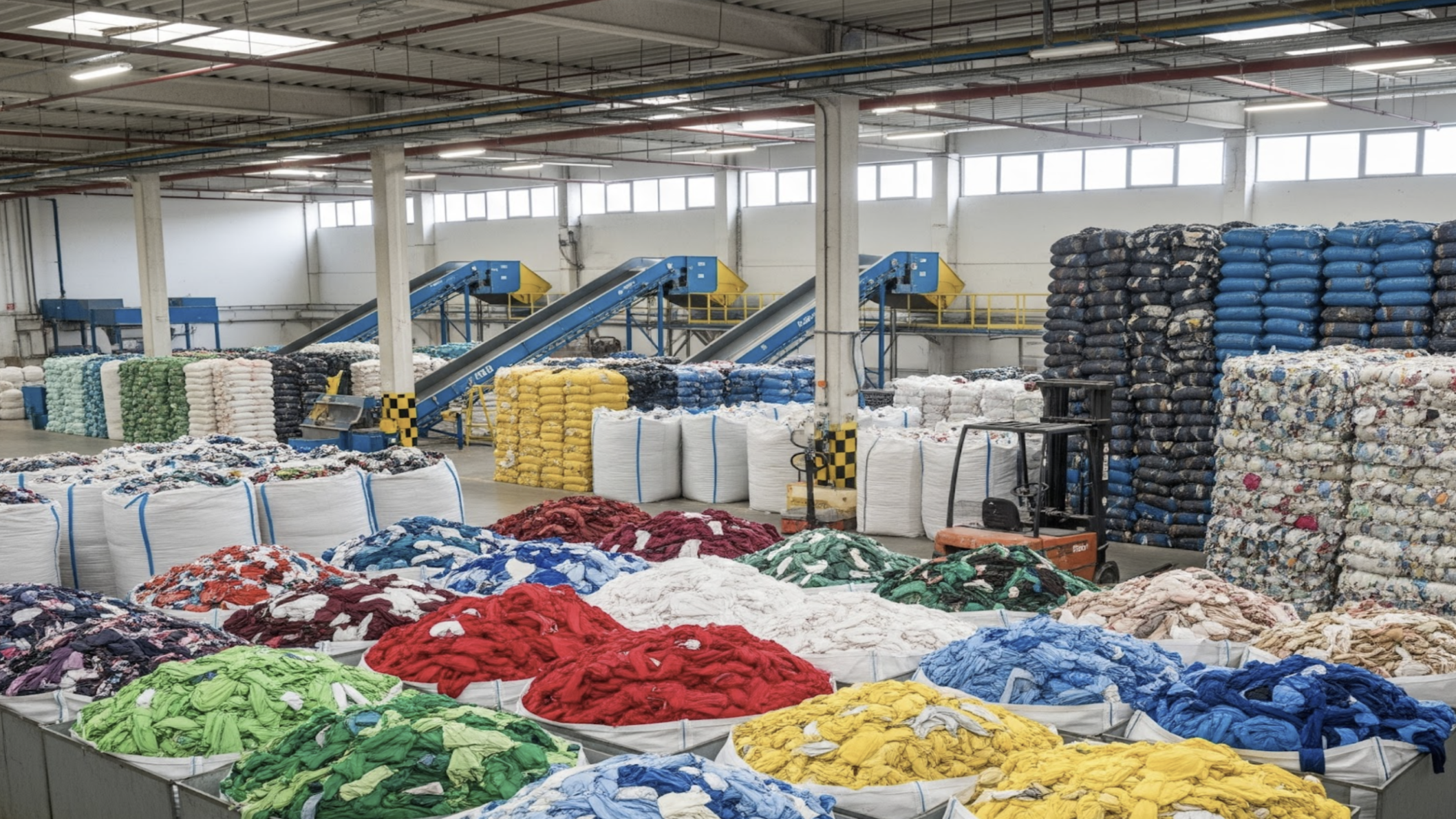
Fashion for Good has launched Project FAE (Feedstock Activation Europe), a major industry initiative designed to tackle one of the most persistent barriers to textile circularity: the lack of sorting and pre‑processing infrastructure needed to transform non‑rewearable post‑consumer textiles into high‑quality feedstock for textile‑to‑textile (T2T) recycling. While Europe is rapidly expanding its recycling capacity, most post‑consumer textiles still end up downcycled, landfilled, or incinerated because the upstream systems required to prepare them for recycling remain fragmented, under‑invested, and commercially uncompetitive.
Today, only a small fraction of non‑rewearable textiles enter T2T recycling. Declining garment quality, tightening trade restrictions, and weakening demand in secondhand export markets have further reduced the outlets available for used textiles, leaving sorters with growing volumes of low‑value material and recyclers without the consistent, specification‑ready feedstock they need. As a result, most recyclers continue to rely on post‑industrial waste, which is cleaner and easier to process but insufficient to meet future demand for recycled fibres—especially as EU Extended Producer Responsibility rules push brands to take responsibility for end‑of‑life textiles.
“Technology is no longer the bottleneck,” said Katrin Ley, Managing Director at Fashion for Good. “What is holding us back is the unglamorous but essential infrastructure—sorting lines, pre‑processing steps, and supply systems—that must exist before a single fibre can be recycled. Project FAE is our attempt to tackle that challenge head‑on, together with the brands, sorters, and recyclers who know this problem better than anyone.”
Backed by brand partners adidas (lead sponsor), BESTSELLER, and Inditex, and supported by strategic partner Rehubs and on‑ground partner Rematters, Project FAE brings together an unusually broad coalition across the value chain. Participating sorters include Boer Group, Circle‑8 Textile Ecosystems, Erdotex, Humana People to People, Texaid, and others, while recyclers span mechanical, thermomechanical, and chemical technologies—from Circ and Circulose to Infinited Fiber Company, Recover, Reju, and WornAgain. Ecosystem partners such as InvestNL, Refashion, Reverse Resources, WRAP, and Global Fashion Agenda add policy, financing, and systems‑level expertise.
The project operates across two parallel tracks. The first focuses on advanced pre‑processing, assessing technologies such as fibre‑blend separation, elastane removal, and contaminant extraction to determine which solutions are ready for deployment and which require further development. The second track aims to design a scalable hub model for Europe: regional facilities that aggregate post‑consumer textiles, apply automated sorting and mechanical pre‑processing, and produce feedstock streams tailored to the specifications of different recyclers. By centralising and automating these steps, the hub model seeks to reduce per‑unit processing costs, improve feedstock quality, and create a viable business case for both sorters and recyclers.
By delivering both technical insights and a commercial framework for implementation, Project FAE aims to lay the groundwork for a functional post‑consumer waste value chain—one capable of supplying Europe’s growing recycling sector with the feedstock it needs. Fashion for Good says the ambition is clear: to turn post‑consumer textiles from a costly waste stream into a competitive raw material, and to accelerate the transition toward a circular, regenerative textile system.